Why Standard Sewing Patterns Fail Your Body
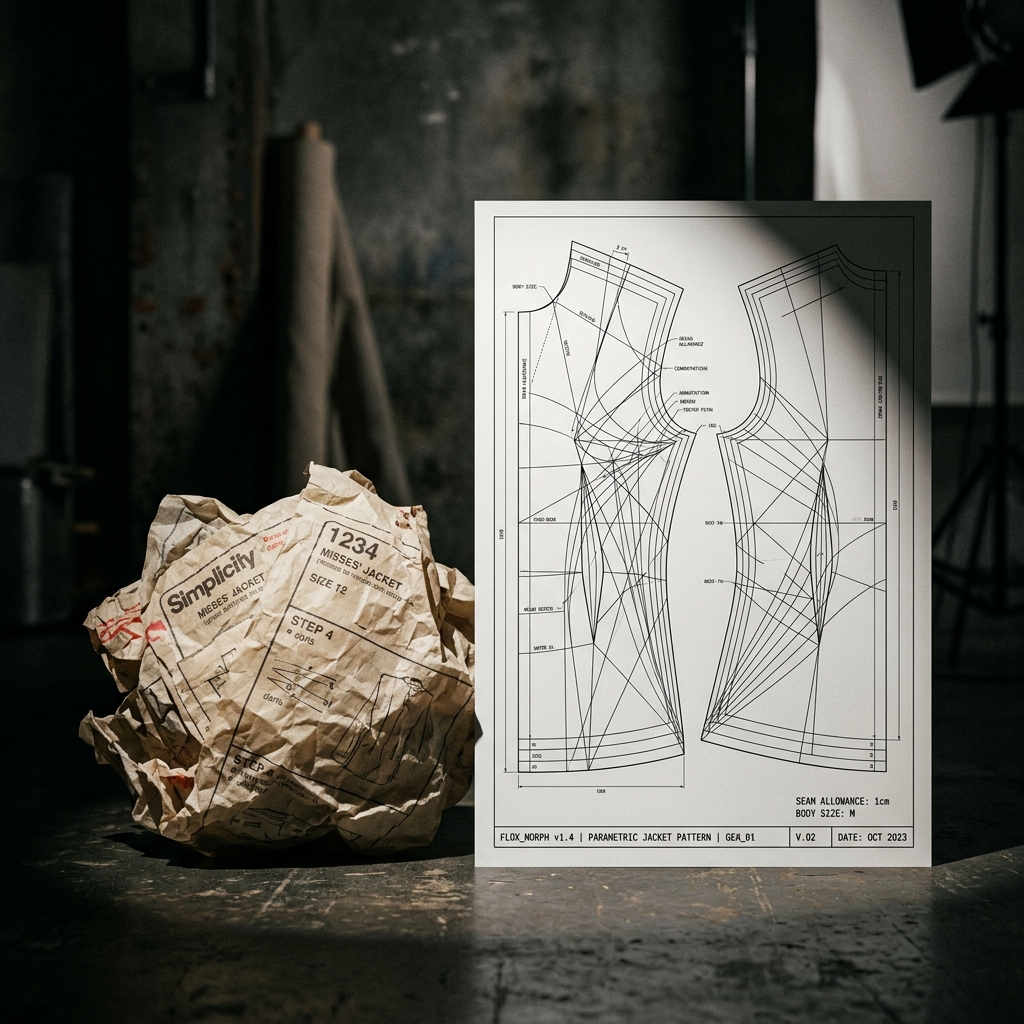
Have you ever spent a week tracing, cutting, and sewing a beautiful paper pattern, only to try it on and realize it fits terribly? You're not alone. The problem isn't your sewing skills; it's the mathematical foundation of standard-sized patterns.
The "Average" Body Myth
The sizing charts used in the commercial pattern-making industry were standardized decades ago. They operate on an archaic assumption of proportionality: if your hips get wider, the industry assumes your shoulders and waist widened by the exact same proportional margin. But human bodies don't scale like 3D models.
When you purchase a "Size 12" pattern, you are actually purchasing a geometric compromise.
Grading Vs. Parametric Drafting
Traditional pattern makers create a 'base size' (usually a size 6 or 8) and use mathematical rules to scale it up and down. This is called pattern grading. When graded to extremes (like a size 20), armholes become massive, necklines drop dangerously low, and dart placements drift completely off the bust apex.
Parametric pattern drafting is different. Instead of scaling a base drawing, the code drafts the garment from scratch using your personal measurements as coordinates.
The Cost of Muslins
Sewists are taught to make "muslins" or "toiles" (test garments) to adjust the fit. This takes hours of your precious free time and wastes fabric. With a made-to-measure engine, the algorithm solves the geometry instantly, eliminating 90% of the fitting issues before your scissors ever touch the fabric.
Try Parametric Sewing for Free
Test our engine with 14 free garment models.